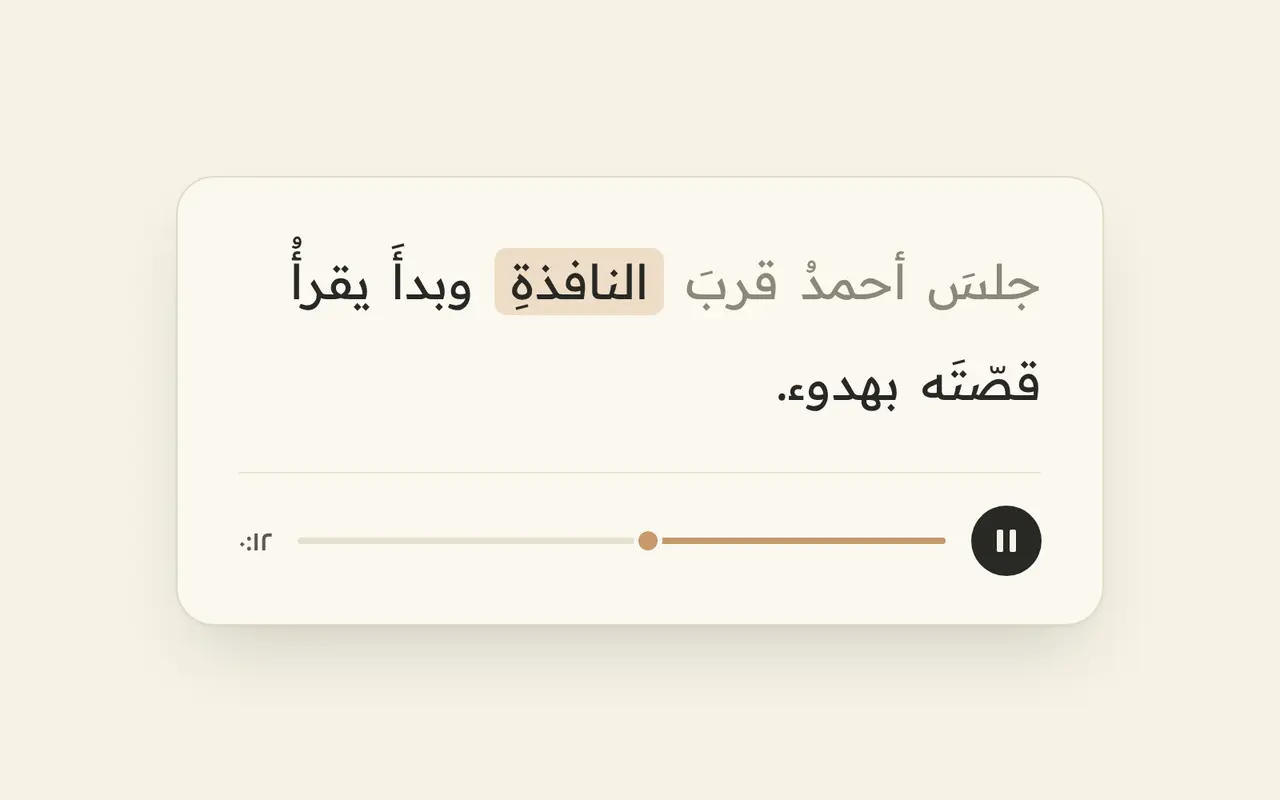
Samsung Innovation Campus capstone with a team of six: an Android app that simplifies hard Arabic text, adds diacritics and reads it aloud, all on the phone. I worked on the app.
10 projects, from a neural network in raw NumPy to planets you can slingshot around a sun. Open any one for the details.
Samsung Innovation Campus capstone with a team of six: an Android app that simplifies hard Arabic text, adds diacritics and reads it aloud, all on the phone. I worked on the app.
A Pygame gravity sandbox: drag to aim, release, and Newton's law decides whether the planet orbits, escapes or falls in.
10% → 80%
Test accuracy: ReLU, then LeakyReLU
A two-layer network that reads handwritten digits, written in raw NumPy with hand-derived backpropagation.
Outlook
|-- Sunny
|   Humidity
|   |-- High   -> No
|   `-- Normal -> Yes
|-- Overcast   -> Yes
`-- Rain
    Wind
    |-- Weak   -> Yes
`-- Strong -> NoShannon entropy and information gain worked by hand, then automated into a recursive ID3 builder that prints the tree.
Both clustering algorithms from first principles, compared on how they handle noise and outliers.
VIF = 1 / (1 − R²)
AveRooms and AveBedrms: r ≈ 0.85
OLS, SGD, Lasso and Ridge compared on California house values, with a VIF diagnosis of correlated features.
Skew 177
187K listings · 20 columns · price distribution
Exploratory analysis of a 20-column housing dataset: cleaning, missing data and a price column with a skew of 177.
Planets that pull on each other in a VPython 3D scene, with collisions and labelled bodies.
A 3D ball thrown at any angle, slowed by drag and friction, bouncing with set elasticity.
w ← w + η(y − ŷ)x
| x₁ | x₂ | OR |
|---|---|---|
| 0 | 0 | -1 |
| 0 | 1 | 1 |
| 1 | 0 | 1 |
| 1 | 1 | 1 |
A single neuron that learns logic gates, starting from random weights and stopping at zero error.
I'm 19 and I learn by rebuilding things from first principles: neural networks, decision trees and clustering in raw NumPy, and gravity you can throw planets into. If I can't write it from scratch, I don't consider it understood yet.
I started with physics simulations: a ball thrown with drag and bounce, a solar system in VPython, and a Pygame window where you slingshot planets around a sun. That turned into machine learning, where I write every algorithm by hand before touching a library. My MNIST network is NumPy matrix maths with hand-derived gradients, and switching ReLU to LeakyReLU took it from 10% to about 80% accuracy. I also do exploratory data analysis on real datasets, such as 187,000 house listings, using Pandas and Seaborn. At Samsung Innovation Campus I studied AI and machine learning, and in a team of six built Bayan, an Android app that simplifies Arabic text for readers with dyslexia.